
MMMM
Mind · Muscles · Movement · Music
A model for mastering the mechanism of mind, movement, and music
Developed by Dr Heleen du Plessis
© Heleen du Plessis, 2026
Mind–Muscles–Movement–Music (MMMM) is a research-informed educational framework for understanding the causes of muscular tension, pain, and injury in performers, and for developing the capacity to prevent, resolve, and move beyond them.
“Heleen du Plessis’s Mind-Muscle-Movement-Music methodology is one of the most important pedagogical discoveries for injured musicians in recent memory. As a cello professor, I have used her exercises with students and seen the results firsthand.”
Miranda Wilson, Professor of Cello, University of Idaho
Why MMMM is needed
Musculoskeletal tension, pain, and injury are not rare among musicians—they are the norm.
Studies suggest that more than eighty percent of musicians experience these problems at some point during their training or career. Yet despite decades of treatment, education, and research, they remain widespread. Their persistence suggests that something important is still being missed, and that many current approaches address only part of the problem.




The missing link
Many performers have been told to relax, to release, or to change a movement, and found they could not, however hard they tried and however well they understood the instruction. There is often a gap between what is taught and what is learned, and between what performers intend to do and what their bodies are actually able to do.
Knowing what to do is not the same as being able to do it.
The reason is often not the movement itself, but the connection between the mind and the muscles responsible for producing it. The pathways that allow a muscle to be perceived, activated, coordinated, and controlled can become underdeveloped or disrupted by injury, pain, stress, inactivity, or years of habit. When they are, instruction has nothing to land on. A performer may do an exercise with the wrong muscles, hold a posture using the wrong ones, or reinforce the very patterns causing the problem while trying to do exactly the right thing.
Trying to change movement without first addressing the mind-muscle connection is like trying to fix a light without checking whether it is plugged in.
MMMM addresses this missing educational link by making explicit the processes through which movement is perceived, learned, organised, and controlled. By developing the mind–muscle connection and the capacities that underpin learning, it enables performers to translate understanding into reliable action.
From invisible to visible
Music is the visible and audible result of invisible processes. What you can’t see is how your body produced it: which muscles did the work, how hard they worked, and which ones kept holding on long after they were needed.
You can’t fully trust how playing feels because most of this happens through habit. It develops over years and runs largely outside awareness. Tension that has been with you for years stops registering as tension. Effort that should concern you feels normal.
Two performers can produce the same phrase with completely different muscular effort. One does it with ease. The other pays for it in tension, fatigue, and eventually pain. The difference is rarely a lack of skill or effort.
The challenge is that the processes responsible for it are largely invisible.
What cannot be objectively observed is difficult to perceive accurately, understand correctly, or change reliably.
MMMM starts by making it visible.
Evidence, not feeling
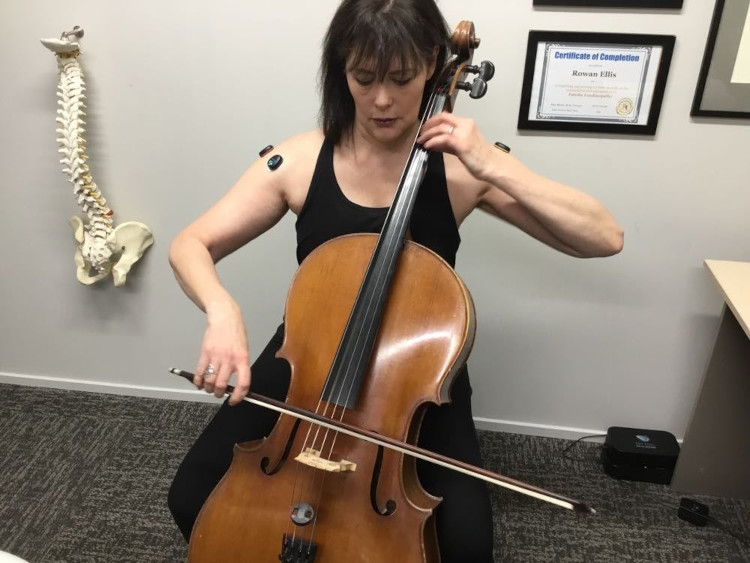
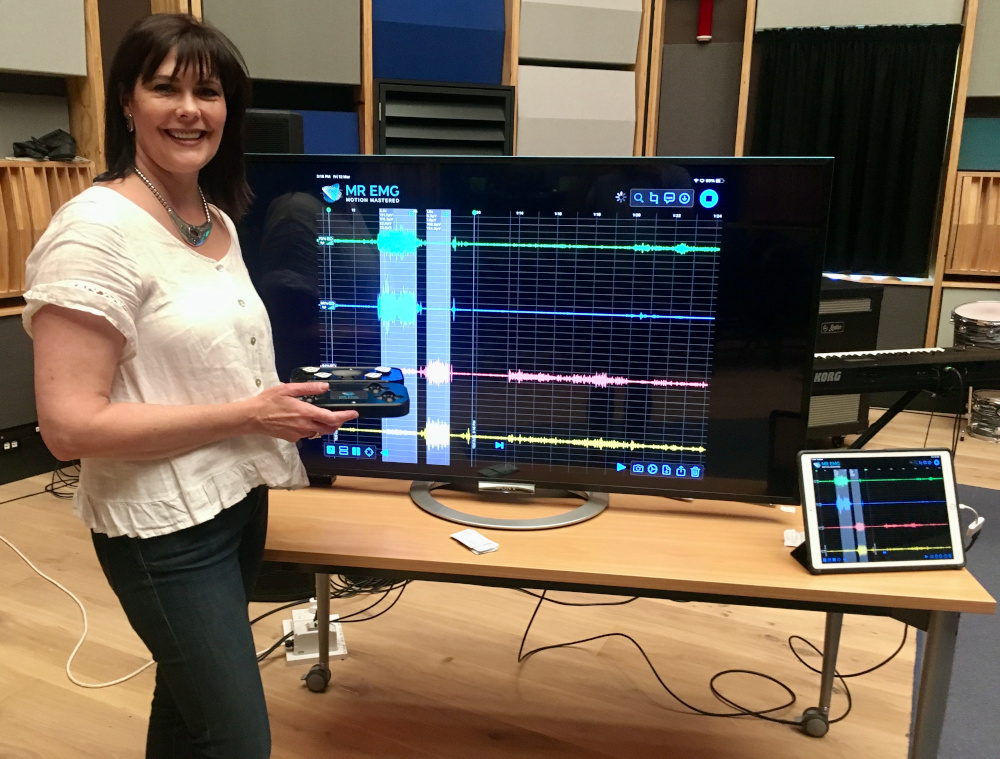
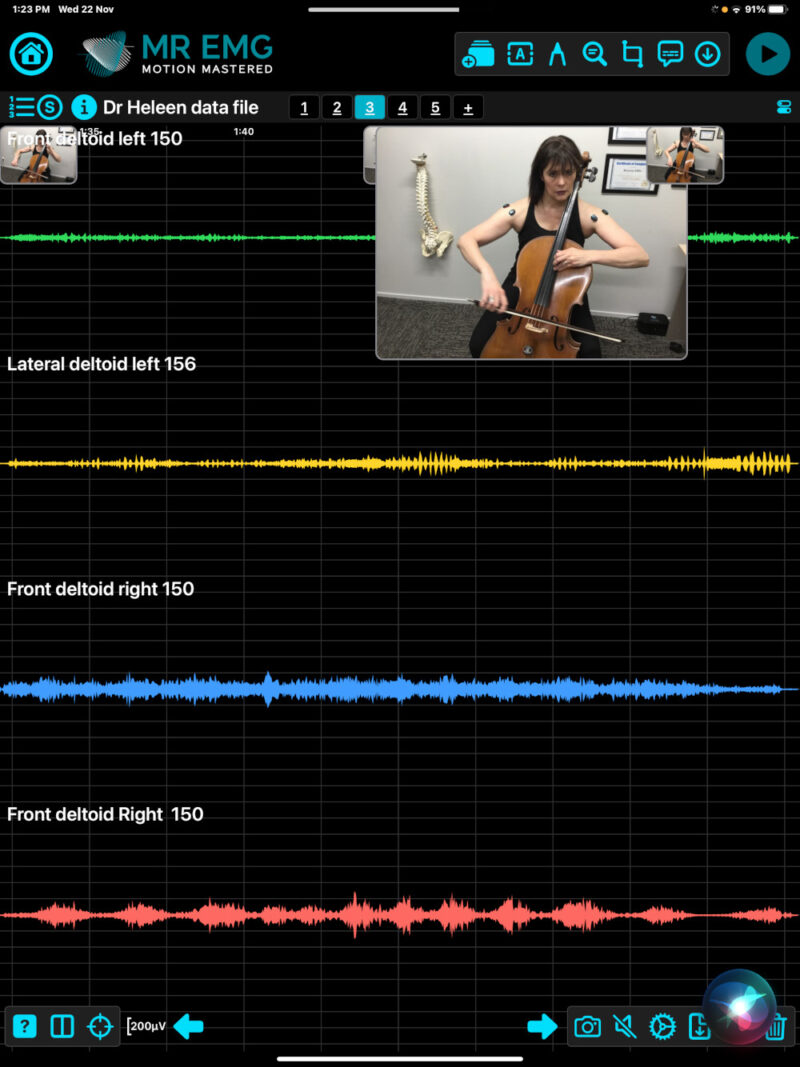
A distinctive feature of MMMM is the use of surface electromyography (SEMG) to make these hidden processes visible. Small sensors placed on the skin detect the electrical activity associated with muscle contraction and release, displaying it in real time as colourful waveforms on an iPad.


Awareness is verified, not assumed.

For the first time, performers can see which muscles are active, how hard they are working, and exactly when they switch on and off. A muscle that feels relaxed may be working at full effort. A movement that feels correct may be produced by an entirely different muscular pattern than intended. Changes can be observed, compared, and confirmed immediately rather than inferred from sensation alone.
Neither being mystical or magical, awareness depends on a tangible two-way communication pathway between the brain and muscles that can be developed, strengthened, and restored.
By making the invisible observable, SEMG helps performers identify inefficient patterns, refine perception, strengthen mind–muscle connections, increase awareness, develop voluntary control, and reorganise movement with precision. Tension, pain, and limitation become things that can be understood and changed—not simply endured.
“Heleen did not tell me to just relax. She worked with me to identify and strengthen weak muscles, muscles I didn’t even know I had. I feel so much freer when playing, and my shoulder and back pain have significantly decreased.”
Grace Shaw, viola player and PhD student
“The M-M-M-M methodology is grounded in surface electromyography research and gives players and teachers a concrete, evidence-based framework for understanding why injuries happen and how to manage them. The exercises are simple and immediately applicable, but the science behind them is serious”.
Miranda Wilson, Professor of Cello, University of Idaho
Not what is done to you. What you learn to do yourself.
A model for mastering the mechanism of mind, movement, and music
The name is the model. These are not four separate subjects. They are four parts of the same system, and they operate in the same sequence every time you play.
The mind generates intention. Intention activates muscles. Muscles create movement. Movement produces sound.
Mind → Muscles → Movement → Music
A problem anywhere in that chain can influence everything that follows. Tension in the shoulder is not necessarily a shoulder problem. It may begin in how movement is organised, in a misconception about technique, or in a pattern learned years earlier. MMMM follows the chain back to where the problem originates rather than focusing only on where it appears.
Music ← Movement ← Muscles ← Mind
That is why MMMM is a framework rather than a single fix. It provides a way to understand how mind, muscles, movement, and music interact, identify where the system is breaking down, and reorganise it so that change is meaningful, transferable, and lasting.
“Dr du Plessis has established specific uses and applications for musicians, not only for assessing muscle functioning and imbalances addressing musculoskeletal issues but also the unique applications of surface electromyography biofeedback while playing and coaching musicians. She has also developed specific evidence-based exercise rehabilitation programs that enhance the return of lost muscle functioning, improve mind-muscle connections, and create freedom of movement”.
Rowan Ellis: Accredited Exercise Physiologist, SESNZ, Director and founder of MR EMG (https://www.mremg.com)

What MMMM does differently
MMMM focuses on the processes that transform instruction into performance: how movement is perceived, learned, organised, and controlled.
Looks beneath the music
MMMM works on the body underneath the music—the layer your teacher can hear the results of but cannot directly see.
Focuses on causes, not just symptoms
It examines how movement habits are formed, how misconceptions develop, and how patterns of tension, compensation, and control become reinforced over time.
Combines objective evidence with subjective experience
A central feature of MMMM is the combination of objective measurement and lived experience, allowing awareness to be verified rather than assumed.
Considers the whole performer
Physical, psychological, social, individual, and environmental factors all influence how movement is perceived, organised, and regulated. MMMM therefore considers the performer as a whole rather than focusing on a single symptom or body part.
Recognises individual differences
Rather than applying a standard solution, MMMM seeks to understand how each performer organises movement and what capacities need to be developed.
Develops independence
The aim is to equip performers with the understanding and skills to identify causes, make informed decisions, and become active participants in their own development, recovery, and long-term performance health.
The philosophy behind MMMM
MMMM reframes performance-related tension, pain, and injury not as an unfortunate side effect of high-level artistry, but as a learnable, preventable, and reversible outcome of how movement, perception, and muscular control are understood—or misunderstood—throughout musical training.
Address risk factors early, consistently, and systematically.
It argues that addressing risk factors early, consistently, and systematically is not a luxury reserved for elite professionals or injured musicians, but a foundational responsibility of performance education at all levels.
A sustainable and fulfilling performance career is not supported by talent or effort alone, but by the ability to learn, adapt, and care for the body that produces the work. Prioritising physical and mental health is therefore not a detour from artistic excellence, but its foundation.
Learn, adapt, and care for the body.
Towards informed, proactive teaching.
By making the mechanisms of tension, pain, and injury visible and teachable, Mind–Muscles–Movement–Music challenges the field to replace silence, denial, and reactive care with informed, proactive teaching and learning.
“Heleen showed me when I was using particular muscles, and helped me build connections between my mind and my muscles. My pain has reduced, and if I do have pain, I know why, and I know what to do about it. Heleen has helped me in a way my physiotherapist never could.”
Lucy Porter, cello student
A Vision for Sustainable Performance
MMMM aims not only to advocate for better movement education in music, but to provide a practical and teachable framework for understanding how mind, muscles, movement, and music interact. In doing so, it seeks to give performers, teachers, and institutions the tools to prevent injury, develop sustainable performance practices, and support long-term artistic and personal wellbeing.
“Dr. Du Plessis is the leading expert in rehabilitating instrumental musicians’ performance-related injuries. Her work is essential for injured musicians who want to return to pain-free playing, for teachers looking for practical tools to help their students, and for health professionals working with musicians. I recommend her work without reservation.
Miranda Wilson, Professor of Cello, University of Idaho
Where it comes from
MMMM grew out of Dr Heleen du Plessis’s own recovery. As cellist, she spent years in pain that nearly ended her career, having tried most conventional treatments and awareness-based approaches without lasting relief.
The turning point came through SEMG assessment and rehabilitation with exercise physiologist Rowan Ellis, founder of MREMG. For the first time, patterns of muscle overactivity and loss of voluntary control became visible—patterns that had remained hidden despite years of treatment and investigation. She recovered fully, and has been free of pain for twelve years.
What followed was a decade of research and teaching.
MMMM brings together fields that usually work in isolation: research on performance-related injury, biomechanics, SEMG, neuroscience, performance psychology, sport and exercise science, learning theory and pedagogy.
This experience ultimately became the foundation of the MMMM framework and became the foundation of a Performance, Health and Well-being course at the University of Otago, which the university’s academic committee described as a great innovation. It has been presented in workshops, conferences and lecture-demonstrations internationally since 2016.
Dr du Plessis provides insight into her recovery from debilitating spinal pain and the benefits of surface EMG biofeedback.
Dr du Plessis shares the impact of using MREMG as a coaching tool for her Cello students and the immense benefits of biofeedback.
Who it’s for
MMMM is for musicians who’ve hit something they can’t play their way through: an injury that keeps returning, tension that won’t release, a limit that more practice only deepens, or the familiar gap between knowing what to do and being able to do it. You have likely tried the usual answers and found them partial.
It is also for the teachers and institutions who work with those musicians, and who want to understand the mechanics of what they are hearing, not only its results.
It isn’t a treatment you receive. It is a set of skills and understanding you carry into every practice session, rehearsal, and performance.
What the work looks like
A session begins by reading what your body actually does: at rest, in simple movements, and while you play. The data shows where effort is going, and where it is being wasted or held.
From there, the work is specific to you. There is no standard programme, because no two players carry the same patterns. The exercises start in simple, supported positions where accurate control can be built without strain, then transfer gradually into playing. You try a movement, see it on the screen, adjust, and see the adjustment confirmed. Over time, the better pattern becomes the one your body reaches for by default.

Looking ahead
At present MMMM is presented in individual teaching, workshops, and lecture demonstrations.
A book, Mind–Muscles–Movement–Music, outlining the framework in detail is currently in preparation. It will present the underlying concepts, supporting research, and practical applications in a structured and comprehensive form.
Future developments will include expanded learning resources, articles, videos, workshops, and structured teaching programmes designed to make the framework accessible to performers, teachers, and institutions.
Continue exploring
This introduction presents the core ideas of MMMM, but it is only the beginning.
The MMMM Knowledge Hub explores the underlying research, key concepts, practical applications, common misconceptions, and the principles that shape movement, performance, recovery, and sustainability
If you recognised yourself in any part of this page, that is a good place to begin.